> ## Documentation Index
> Fetch the complete documentation index at: https://docs.ulm.m1amdocs.com/llms.txt
> Use this file to discover all available pages before exploring further.
# Remove User Attribute Process
This Process removes a registered authentication identifier (email address, mobile number, or alias) from a Digital Identity Management User entity.
## About AuthN IDs
Here are a few basic things to remember about how authentication identifiers (authN IDs) work in Digital Identity Management:
* AuthN IDs are commonly referred to as usernames. AuthN IDs include emails, mobile numbers, and aliases.
* Aliases are unique, non-verifiable "nicknames" the user can register to use for authentication.
* Digital Identity Management supports the ability for a user to register, verify, and use multiple authN IDs.
* When a user registers an authN ID, it is stored on the User entity in the Digital Identity Management data store.
* An user's authN IDs are stored on the Digital Identity Management User entity as attributes.
* Specifically, each authN ID type is grouped under its own type array.
* Each individual authN ID has its own unique identifying number (which the Process requires)
* See the next section for a visual aid.
* Every Digital Identity Management User requires at least one verified authN ID (the User entity will not be activated without one).
* The exception to this rule are Soft Profile Users, which are created by and "owned" by regular Users.
## AuthN IDs are User Entity Attributes
Digital Identity Management is built on top of a user-centric and entitlement-specific data model comprised of Digital Identity Management data entities. Each entity type is defined by a set of default and extensible attributes. Some attributes are simple name/value pairs, and others are more complex arrays (i.e., an array objects that make up a single attribute value).
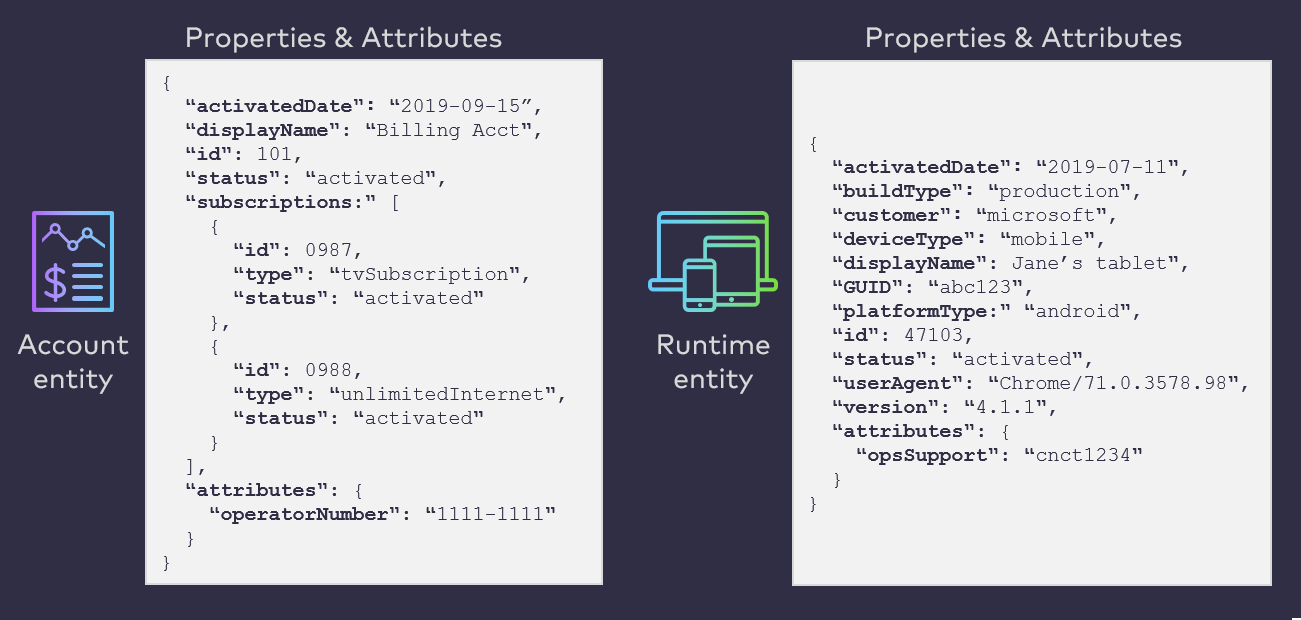 An user's authN IDs are stored as attributes on the Digital Identity Management User entity, under the `attributes` array.
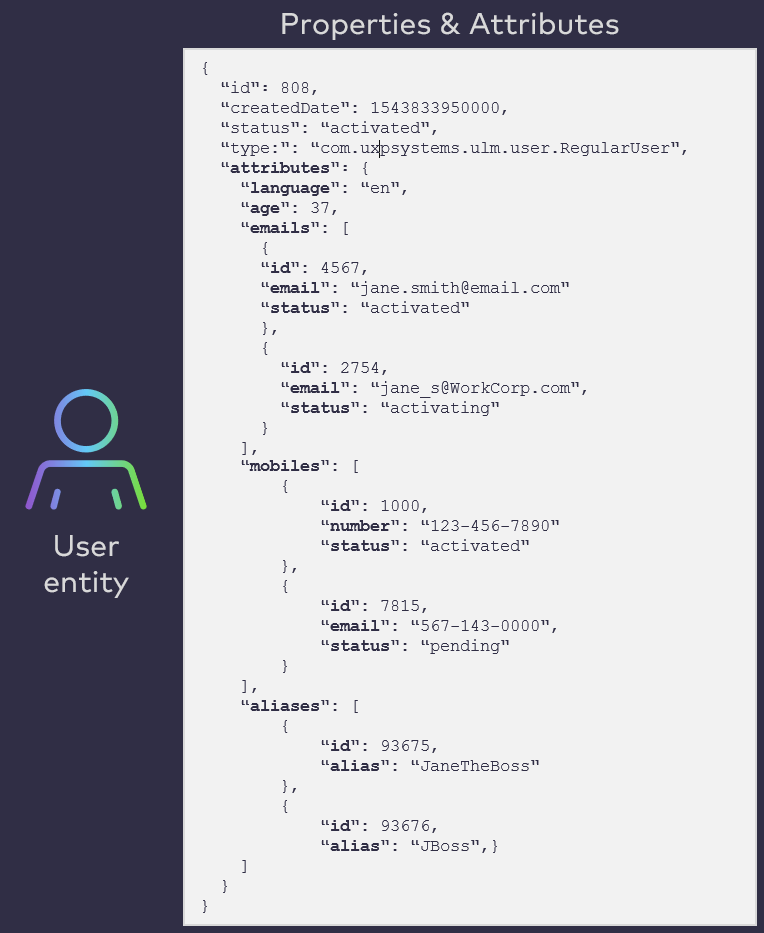 The Remove User Attribute Process removes a single email, mobile number, or alias from the User entity. As Digital Identity Management service continues to evolve, additional attributes may be supported on the User entity, and this Process can be used against those as well.
## Process Flow
This flow describes the Remove User Attribute Process at a high level.
**Preconditions**
* The user is currently authenticated in Digital Identity Management.
**Basic Flow**
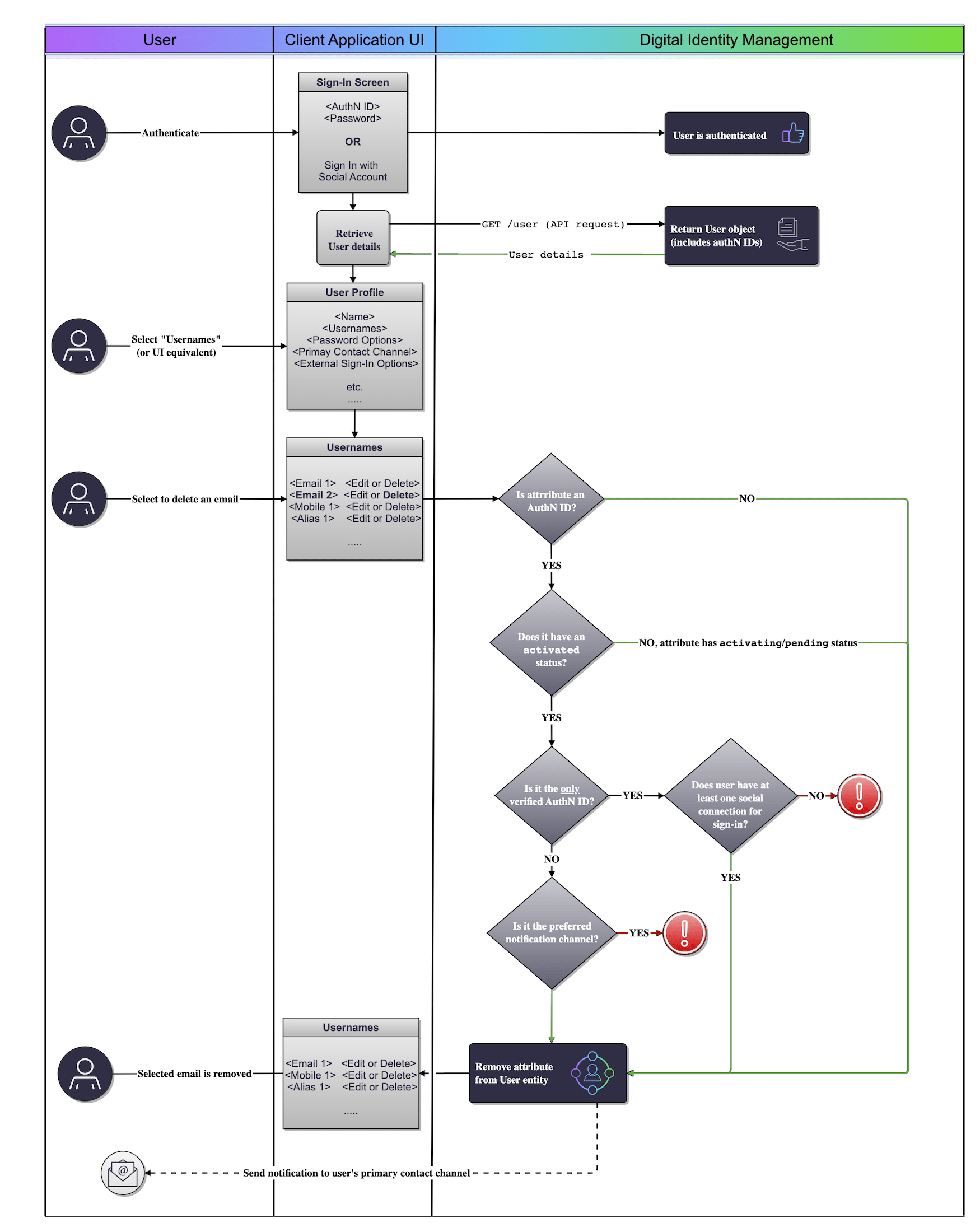
1. The user selects to delete an email address, mobile number, or alias.
* Once a user authenticates, the client application can retrieve a list of all the user's currently authN IDs with the GET /user API, and then display those authN IDs to the user on the relevant UI page.
* The client application then needs to supply the selected authN ID in the format specified by the Process.
2. Digital Identity Management checks the status of the selected authN ID.
* The process can remove the selected attribute without issue if:
* The authN ID has an **`activating`** or **`pending`** status (i.e., it is unverified).
* The attribute is an **`activated`** authN ID, but the User entity has at least one other **`activated`** authN ID.
* The attribute is the only `**activated**` authN ID, but the user has at least one [associated social account](c_onboardAuthenticateUserSocial).
* The attribute is **not** the user's current preferred notification channel.
* The process halts if the selected attribute does not meet the above criteria.
3. (**Conditional**) If the selected authN ID is the user's current preferred notification channel, then Digital Identity Management prompts the user to first set a new preferred channel. The process then ends, and the user will need to retry.
4. Digital Identity Management then removes the attribute from the User ID.
**Postconditions**
* The selected email, mobile, or alias is removed.
* The user can not longer use that removed value to authenticate.
**Possible or Common Errors**
* The selected attribute is not valid for removal.
* The attribute value does not exist or was not found.
* The selected attribute is the preferred notification channel. First set a new notification channel, and then try again.
* The selected attribute is the user's only verified authN ID.
* Multiple results found with the provided attribute value.
## App Settings
This Process currently has no relevant settings to configure the Process behavior.
## User Journey Diagram
This flow diagram illustrates a standard **Remove Email** user journey using the **Remove Attribute** Process.
\[product: dim]
 \[/product: dim]
This Process can technically support removing any item stored at the `attribute` level on the User entity. However, authN IDs are currently the only applicable use case at this time.
## Use Cases
* [Remove email address / mobile number](c_useCaseRemoveAuthnID)
* [Remove attribute errors](c_removeAuthNErrors)
* **[Remove user email, mobile, or alias](../topics/c_useCaseRemoveAuthnID)**
* **[Remove AuthN ID Errors](../topics/c_removeAuthNErrors)**
**Parent topic:**[Identity Management Processes](../images/c_identityProcesses)
This documentation is built and hosted on [Mintlify](https://mintlify.com), a developer documentation platform.