

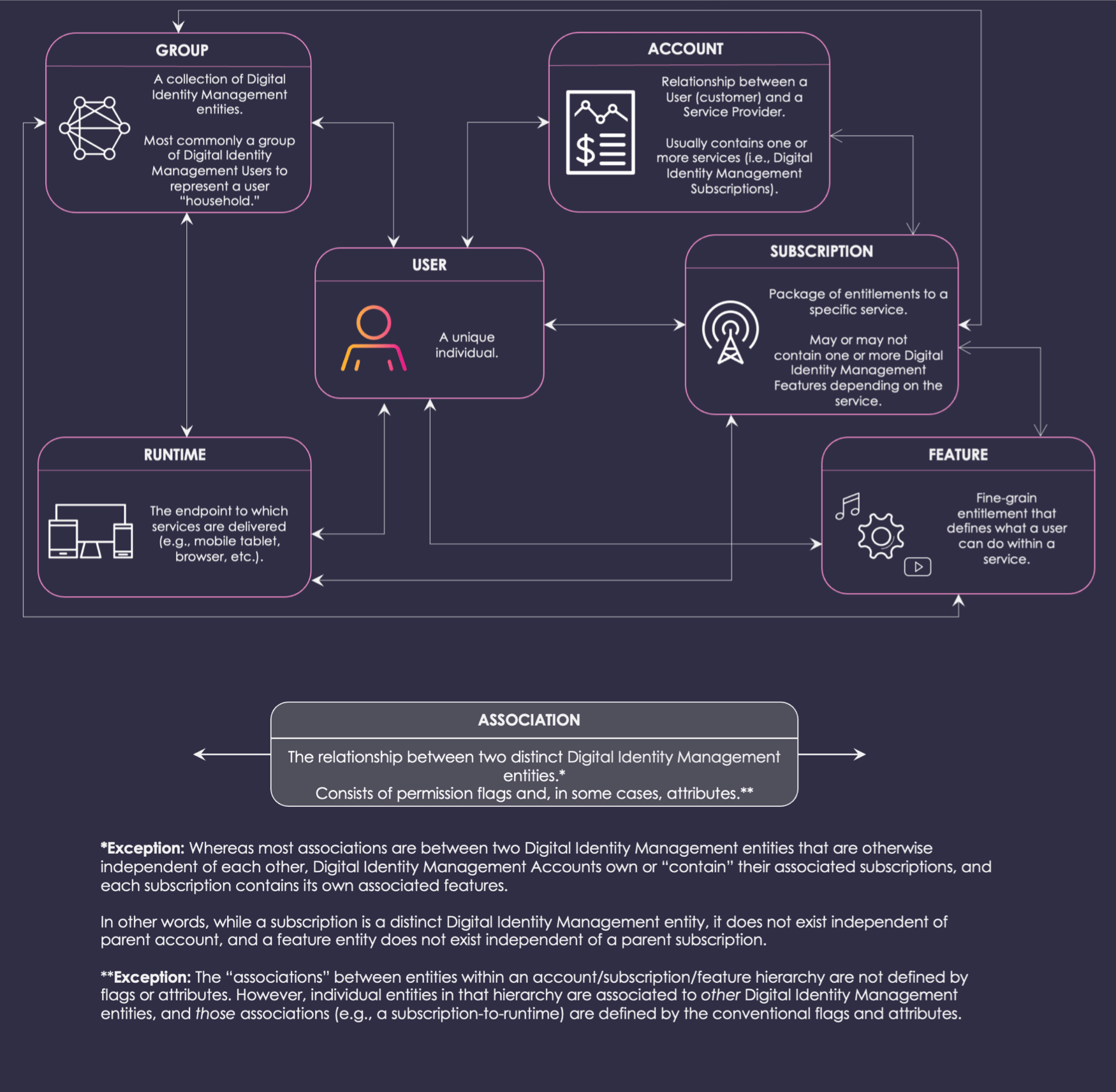
- User – The primary Digital Identity Management entity. It represents an individual person.
- Group – A collection of entities (e.g., a group of users within a household)
- Account – Represents an operator’s billing account for one or more services.
- Subscription – Represents an instance of a service. Cannot exist without a parent account entity
- Feature – A very specific functionality of a service. Cannot exist without a parent subscription entity.
- Runtime – Represents an individual device, either physical (e.g., tablet) or virtual (e.g., web browser).
Properties & Attributes
Digital Identity Management entities are composed of properties and attributes or data field names and their respective values. Each entity includes a set of default properties, and anattributes property that contains additional entity-specific metadata.
In addition to this, any two entities are linked to each other by way of an association entity, which itself consists of permission flags and attributes that define the relationship between those particular entities.
See the entity-specific reference topics for more details on what is captured in each entity.